Author: Michele Ainley

  • Saint Caillin of Fenagh, November 13

    November 13 is the feast of Saint Caillin of Fenagh, a saint of whom many stories are told. The character of some of these tales gave the writer of the following account, the 19th-century Anglican cleric Thomas Olden, pause for thought, although in truth his reservations were often shared by Catholic writers of the period. The understanding of hagiography as a distinct genre of writing with its own logic and rules didn’t exist at this time. I hope to explore some of the episodes referred to by Rev. Olden in future posts, there is a wonderful resource on the saint and his writings available online here. The translation of the Book of Fenagh mentioned in the article is also available through the Internet Archive. So, let us enjoy a lively presentation of the life of Saint Caillin, complete with a fascinating account of the relics preserved at his church from The Dictionary of National Biography:

    CAILLIN (fl. 560), Irish saint, son of Niata, was descended from Rudraighe, whose grandson, Fergus Mac Roigh, flourished at the beginning of the Christian era. His mother was Deighe, granddaughter of Dubhthach, chief poet of King Laogaire in the time of St. Patrick. The authority for the history of St. Caillin is the ancient ‘Book of Fenagh,’ a series of poetical rhapsodies, written about 1400, a copy of which with a connecting narrative in prose was made in 1516. This was published in 1875 by Mr. D.H. Kelly, with the competent aid of Mr. W. M. Hennessy, and from an examination of it it appears that the transcriber of the sixteenth century added a good deal which he thought likely to increase the veneration for his saint. But fortunately many of these interpolations are of so extravagant a character that there is no difficulty in distinguishing them.

    Disregarding the fables, which even in 1690 were complained of by readers, we may gather the following facts of St. Caillin’s history from this curious repertory of ancient traditions: ‘The descendants of Medbh and Fergus, viz. the children of Conmac, Ciar, and Core, grew and multiplied throughout Ireland. The children of Conmac especially were in Connaught.’ Those were the Conmaicne of Dunmor, kinsmen of Caillin’s. Resolved to remedy the congestion of the population by killing each other, the Conmaicne would no doubt have carried out their plan but for the interference of St. Caillin. By the advice of an angel they sent messengers to him at Rome, whither he had gone for his education. Caillin came first to the place where his own kinsmen, the Conmaicne, were, ‘to prohibit their fratricide and enmity.’ ‘My advice to you,’ said the saint, ‘is that you remain on the lands on which you at present are. I will go moreover to seek possessions and land for you as it may be pleasing to God.’ St. Caillin then left Dunmor, where this conversation seems to have been held, and went to Cruachanaoi in the county of Roscommon, thence to Ardcarna, near Boyle, where his friend Bishop Beoaedh lived. Passing on to the east, he crossed the Shannon, and obtained land at Moynishe in the county of Leitrim, and finally reached Dunbaile in Magh Rein, afterwards and still known as Fidnacha or Fenagh, so called from the wooded character of the country. In all these places, which are included in the counties of Roscommon, Mayo, Leitrim, and Longford, the Conmaicne afterwards had settlements.

    When he arrived at Dunbaile, then the residence of Fergna, king of Breifney, he endeavoured to persuade the king to become a Christian, but without success; the king ordered his son Aedhdubh to expel St. Caillin and his party. The prince accordingly proceeded to obey the order but when he ‘found the saint and his psalmists engaged in prayer and prostrations,’ he and his followers forthwith became believers. Aedhdubh was afterwards baptised, and then presented the fortress of Dunbaile to St. Caillin that he might erect his monastic buildings within it. The historical accuracy of this statement is rendered probable by the existing remains at Fenagh. The ruins of St. Caillin’s Church are still to be seen, and traces of the stone fortress, which was of great extent, are still visible (PETRIE). The fortress was of great antiquity even in the sixth century, being also known as Dun Conaing, from Conaing the Fearless, a prehistoric king to whom its origin was ascribed.

    Enraged at his son’s conduct in not carrying out his orders, King Fergna directed his druids to banish the Christians. Aedhdubh, now a Christian, commanded his men to resist the attack, but here St. Caillin interposed, and the story went that he caused the druids to be turned into stones, which are still standing. On the death of Fergna, who continued obstinate in his paganism, St. Caillin inaugurated Aedhdubh as king; but though now king the prince was dissatisfied with his dark complexion, whence his name of dubh, and requested St. Caillin to transform him into the likeness of St. Riocc of Innis-bo-finne. The saint by means of prayer complied with his request. Similar stories are told in the lives of St. Moedoc of Ferns and St. Finnchu of Brigown, and it may perhaps be regarded as a fanciful way of describing the change for the better wrought in the demeanour of a pagan chieftain under the influence of Christian teaching and example. When recognised as the teacher of the Conmaicne, Caillin bestowed on them as a cathach, or battle standard, a ‘hazel cross with the top through the middle.’ St. Columba in like manner gave a cathach to the Cinel Eoghain. When Caillin’s church of Fenagh was built, it was a matter of importance to attach the tribe as much as possible to it, and to make it their burial-place.

    For this purpose the body of Conall Gulban, the famous ancestor of Aedhdubh, was disinterred, and buried again with great pomp at Fenagh. It is thus we may venture to interpret the story that St. Caillin raised him from the dead, and then buried him again. A remarkable cromlech still to be seen at Fenagh is supposed to mark the site of his grave. Aedhdubh (now become Aedh finn, or the fair, from the change already mentioned) was also buried there, and it is stated that nineteen kings lie in the burial-ground. The church of Fenagh also possessed relics reported to have come from Rome. These are stated to have been ‘the relics of the eleven apostles and of Saints Martin Lawrence and Stephen the martyr,’ and ‘that in which they were preserved was the cloth that the Virgin Mary made, and which was around Jesus when a babe,’ or, as afterwards explained, ‘when he was being fed.’ These objects were kept in a shrine, together with the crozier of the saint and his bell. The bell is still preserved at Foxford, and the shrine was in the possession of the late Dr. Petrie. The tribute to the church as ordained by King Aedh was as follows: The king’s riding horse and his body raiment; the same from every chieftain; the same from the queen and each chieftain’s wife; a cow from every biatach (farmer), and from every chief of a bally; a screpall (three pinginns or pennies) from every sheep owner: a fat cow out of every prey from every son of a king and chieftain; the same from every fosterson and every sister’s son of the race of Aedh. This tribute was due every third year. All the veneration attracted to Fenagh tended to secure the payment of the rental due to the institution, and the chief object of the transcript of the ‘Book of Fenagh’ made in the sixteenth century was to substantiate the claim of the monastery to the tribute.

    When St. Caillin’s end approached he was in the church of St. Mochoemog, who was a kinsman, attended by St. Manchan. After giving directions to St. Manchan as to what part of the burial-ground he was to be interred in, and appointing him his successor, he desired that in twelve years’ time, ‘when his bones should be bare,’ they should be removed to his church at Fenagh. Accordingly they were taken up and enclosed with the other relics in the shrine.

    The dates of his birth and death are not found in the native records; but as we know those of his contemporaries, St. Columba, St. Ciaran, and the two St. Brendans, and as he was the grandson of Dubhthach, St. Patrick’s contemporary, we cannot be far wrong in assuming that he flourished in the second half of the sixth century. His peace-loving disposition is the chief characteristic emphasized by Caillin’s early panegyrists. His day in the calendar is 13 Nov.

    [Life of St. Caillin, MS. 3, 54, p. 6, Royal Irish Academy; Book of Fenagh, Dublin, 1875; Martyrology of Donegal, p. 307; Book of Leinster (facsimile), p. 349 e; Annals of the Four Masters, A.D. 464, and iii. 311; Petrie’s Inquiry into the Origin and Use of the Round Towers of Ireland, pp. 444-5.] T.0.

    L. Stephen, (ed.), Dictionary of National Biography, Volume 8 (London, 1885), 211-212.

    Content Copyright © Omnium Sanctorum Hiberniae 2012-2015. All rights reserved.
  • Saint Sinell of Cleenish, November 12

    On November 12 we commemorate Saint Sinell of Cleenish island in County Fermanagh. The Martyrology of Gorman lists ‘Sinell, Mianach’s mighty son’ among the saints commemorated on this day, as does The Martyrology of Donegal. Yet Saint Sinell seems to have been a more important saint than these unremarkable calendar entries might suggest. Indeed, Father John Colgan recorded the name of ‘S. Senellus, Abbas Monasterii Cluain-inis in lacu Ernensi‘ on a list of The Twelve Apostles of Ireland in his Acta Sanctorum Hiberniae [1]. This would place our saint among the elite group of students of Saint Finnian of Clonard, ‘tutor of the saints of Ireland’.

    It seems too that Saint Sinell had a reputation as a teacher of monasticism in his own right. Whilst there is no Life of Saint Sinell extant, It is common for hagiographers to identify the monastic teachers who shaped the careers of the Irish saints. And just as Sinell is claimed to have been a pupil of Saint Finnian, so Saint Columbanus, according to his biographer Jonas, was initially taught by a monk called Sinilis or Senilis. Previous writers were confident that Sinell of Cleenish was the monk Sinilis, but the current generation of scholars are less certain. Unfortunately, Jonas does not name the place where Sinilis taught, recording only that after Columbanus left his home in Leinster he went to ‘a holy man named Senilis, who at this time was distinguished among his countrymen for his unusual piety and knowledge of Scripture’. Recent scholarly consensus has instead centred around the learned Sillán or Silnán, also known as Mo Sinu maccu Min, master of the computus and abbot of Bangor, the monastery which prepared Columbanus for his great European mission. He would appear to be a credible alternative given that the Hymn in Praise of the Abbots of Bangor describes Sillán as a ‘famous teacher of the world’. A third candidate though has been suggested by Dr Alex Woolf who writes:

    ….Jonas had introduced his readers to a venerable man and teacher, Sinilis, with whom Columbanus studied before entering into monastic profession at Bangor. Sinilis has been identified in the modern scholarship with a future Bangor abbot, Mo Sinu moccu Min (d. 610). An alternative identification, however, may be the Sinell (d. 603) who became bishop of Moville in succession to Uinnianus in 579.

    In support of his suggestion Wolff notes that Saint Columbanus cited the correspondence of Bishop Uinnianus in his own works. He felt this might indicate a link between Columbanus and Moville, which in any case is not very far from Bangor. [2]

    But the reputation of Saint Sinell of Cleenish as a monastic teacher is not solely dependent on a disputed link to Saint Columbanus. The Life of Saint Fintán Munnu records that:

    6.

    Thereafter Fintán departed to read with the wisest man in the whole of Ireland and Britain who was a strict abbot of a church by the lakes of Erne, and he stayed with him for 19 years, reading the Scripture, and there were nine other young men with him. And they were under a very strict [monastic] rule, such that they were not permitted to sieve the flour, but the flour with its chaff used to be mixed with water in a bowl and cooked over stones heated by fire, and this was their daily meal. [3]

    This places Saint Sinell squarely in the mould of those sixth-century Irish monastic leaders who were distinguished not only for their learning but also for their ascetiscism.

    Further testimony to the stature of Saint Sinell among the saints of Erne is provided by the Life of Saint Naile .

    XIII. (29) So then there was convened a conference of meeting and consultation of the clerks of the district assuredly, and of the high saints of Lough Erne without doubt. And there came to attend it Tigernach the long-fair-sided, prompt to recite his hours; Ronan of the appropriate speech, graciously acute; Sinell of the mild appearance, prompt in genuflexion; ….


    (33) …And the clerks asked Sinell the virtuous who without contradiction should perform the baptism, for he was bishop over the noble saints, and was the oldest of the freeborn clerks…. [4]

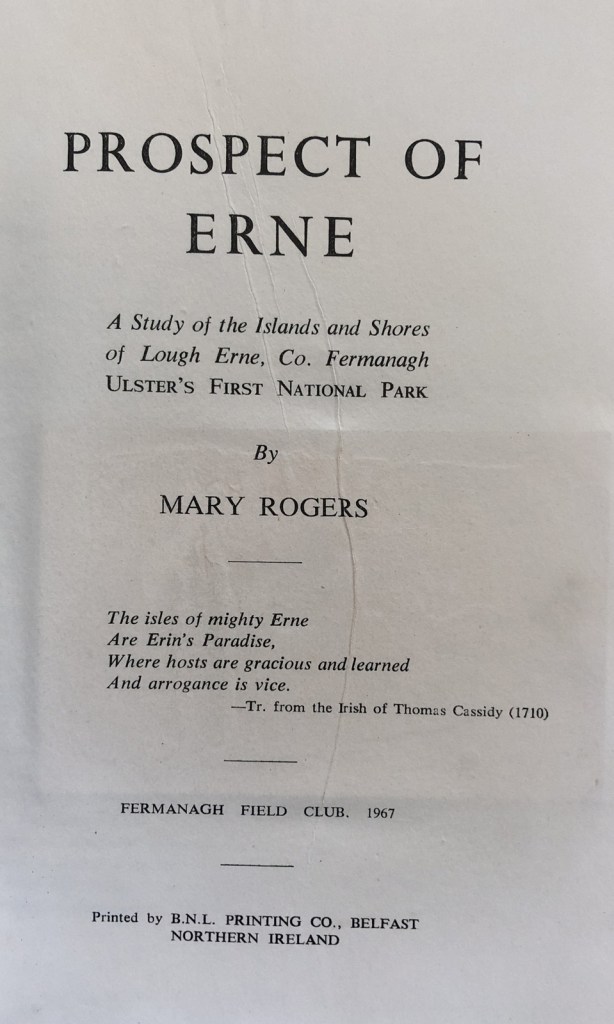
    Writing in 1967 Mary Rogers said of Cleenish:

    The island is large , containing 438 acres. … There is little on the island now to suggest the thriving monastic school of the sixth century. Here, Archdall tells us “Sinell, son of Manacus, or Maynacur, was abbot about the middle of the sixth century.” St. Sinell was a disciple of Finian of Clonard, and in his turn became the teacher of the great Columbanus, who studied Latin, the scriptures, perhaps Greek and Hebrew. Sinell was called “the wisest man in Ireland,” so it was not surprising that the apostle of Gaul and north Italy came here for the his early studies before starting on his great missionary career. The curriculum was wide, including grammar, rhetoric, poetry, history, geometry and astronomy, and the rule was harsh. “The monks of Sinell, Abbot of Cleenish, were not allowed to sift their corn, but were compelled to mix the chaff with the corn and water in a basin, this mixture being cooked with stones, heated in the fire.” The strict fast of the monks was sometimes relaxed for guests, and it is possible that the students did not suffer the full rigours of the religious. Perhaps the very harshness of the rule attracted the ascetic Irish: St. Fintan (or Munnu, as he was sometimes called) lived on Cleenish with Sinell upwards of 18 years. When Columbanus began his European mission in 589, he cannot have had too many forebodings about future hardships, having the experience of the rule of Cleenish behind him!

    One story of St. Sinnell, unconnected with the island, shows him in a more gracious light than has been shed by the account of his austere rule for his monks. The holy well dedicated to St. Patrick near Belcoo that flows out in two different directions, and was known for its cures of nervous and paralytic disorders, is said to have sprung up in answer to Sinell’s prayers. The “pattern” was revived here in 1955, visits to three bullaun stones, the old church and the holy well are paid in the course of the ritual, performed between the last Saturday in July and August 15th, the time associated with Lughnasa. [5]

    There is another interesting reference to Saint Sinell and a holy well in the sources. In his contribution to a 2005 volume of studies on the diocese of Clogher archaeologist Cormac Bourke highlighted:

    A shrine, now lost, which was by implication portable, is referred to in one of the surviving excerpts from a Clogher diocesan register complied in the 1520s. Called the Deargan, ‘red one’, it was said to have been used by St Sinell mac Manaig of Cleenish, County Fermanagh to prime a well. [6]

    The entry from the Register of Clogher cited by Bourke makes clear that Saint Sinell ‘primed’ or prepared the well for its holy function by use of his shrine. Indeed the Register records not only the story of the well and the shrine, but also the tale of how Saint Sinell acquired his land:


    There succeeded to him Bishop Sinell, in whose time here emerged the well of living water which is called Glais Deargan, called from glais and from deargan Sinyll, or called from clays (that is, a ditch) and deargann, because the Blessed Sinell having made a ditch for water placed his shrine, called deargann, in it and then at the saint’s prayer the living water issued which is called glais deargann and now issues and will issue until the Day of Judgment. The same Sinell also revived from the dead the daughter of the king of Airghialla and restored her alive to her father, for which reason her father gave to him and to the church the land which is commonly called Cairttha-Sinyll. To him, Sinell, is consecrated the church called Clainynis-Locha fa-Erne [Cleenish]….

    Bourke wonders too if another artefact found in the vicinity of Cleenish might be associated, if not with our saint, at least with his island. In 1956 a wooden horn ‘shaped from a solid piece of yew, to which a mouthpiece and mounts of bronze are attached by rivets’ [8] was discovered during dredging of the Erne near to the church of Saint Senach at Derrybrusk, opposite Cleenish island. He offers an intriguing speculation about the horn’s possible purpose:

    On Cleenish, on the side furthest from Coolnashantan/Derrybrusk, lay the church of Sinell mac Manaig, and it is not impossible that the horn was used at the river crossing to sound signals to a ferryman.

    As support for this conjecture, Bourke cites a letter of 1517 written by the Papal Nuncio to the court of Henry VIII who noted ‘we sounded a horn and gave a signal with a white cloth tied to a pole’ as his method of alerting the ferryman whilst waiting to cross to Station Island at Lough Derg, County Donegal. [9]

    It is a pleasing image to think of the peace of Lough Erne being broken by the sounding of this wooden horn when the monks of Cleenish needed to leave their island home.

    Thus the evidence suggests that Saint Sinell of Cleenish, whether or not he was the teacher of Columbanus, had a reputation for the sanctity, learning and asceticism typical of monastic saints of the mid sixth-century. The Annals do not appear to record the date of death of Saint Sinell but do note that at the year 1100 ‘This year the church of Saint Sinell of Clain-iais was founded.’ This is interpreted by most commentators as referring to either a rebuilding or to a re-dedication of the original church of Saint Sinell.

    Note: This post, first published in May 2026 replaces the original post on Saint Sinell from 2015.

    Notes and References

    [1] (The Acta Sanctorum Hiberniae of John Colgan, facsimile edition, Dublin, 1948, p. 405).

    [2] Alex Woolf, ‘Columbanus’s Ulster Education’ in Alexander O’Hara, ed., Columbanus and the Peoples of Post-Roman Europe (OUP, 2018), p.91.

    [3] Roy Flechner, trans., Life of Saint Fintán, alias Munnu, abbot of Tech Munnu (Taghmon, Co. Wexford esearch.ucc.ie/celt/document/T201046.

    [4] C. Plummer, Miscellanea Hagiographica Hibernica (Brussels, 1925), 110-114.

    [5] Mary Rogers, Prospect of Erne – A study of the Islands and Shores of Lough Erne, Co. Fermanagh (Belfast, 1967), 102-104.

    [6] C. Bourke, ‘Medieval Ecclesiastical Metalwork from the Diocese of Clogher’ in H. Jefferies, ed., The Diocese of Clogher, (Dublin, 2005), p.27.

    [7] K. W. Nicholls, The Register of Clogher, in Clogher Record, Vol. 7, No. 3 (1971/1972), pp. 361-431.

    [8] John Purser, ‘Reconstructing the River Erne Horn’ in Ulster Journal of Archaeology, Third Series, Vol. 61 (2002), pp. 17-25. The paper includes an interesting illustration from The Vespasian Psalter showing King David amongst a group of musicians, some of whom are playing exactly the same sort of horn as found in the Erne.

    [9] Bourke, op.cit., p.33 ; Mary Purcell, ‘St. Patrick’s Purgatory: Francesco Chiericati’s Letter to Isabella d’Este’, Seanchas Ardmhacha: Journal of the Armagh Diocesan Historical Society,
    Vol. 12, No. 2 (1987), pp. 1-10 at p.7.

    Content Copyright © Omnium Sanctorum Hiberniae 2012-2026. All rights reserved.

  • Irish Devotion to Saint Martin of Tours

    November 11 is the feastday of one of the fathers of Gaulish monasticism, Saint Martin of Tours, whose Life by Sulpicius Severus influenced the future writing of hagiography. Martin was a saint much venerated by the early Irish Church. The Martyrology of Oengus pays him a glowing tribute in its entry for November 11:

    Saint Martin

    a noble simile
    the mount of gold

    of the western world.

    while the scholiast adds:

    Saint Martin of Tours, of Gaul was he.


    Martin a soldier, honour not slight, of Gallia Lugdunensis, a fully-gentle son of the race of the kings, son of Manualt and Abrasin.


    noble simile etc., i.e. noble for him is his resemblance to gold propter etc. Martin out of Martin’s Tours in the south of Frankland : of the Gauls was he, ut dixit quidam : Martin a soldier, honour without prohibition etc. Gold is he propter etc.

    Michael Richter has a chapter on the Irish devotion to Saint Martin in his book ‘Ireland and her Neighbours in the Seventh Century’. He takes as a starting point the early 9th-century Book of Armagh, a manuscript containing three distinct groups of material (1) A complete text of the New Testament, (2) A dossier of materials on Saint Patrick and (3) almost the complete body of writings on Saint Martin by Sulpicius Severus.

    Contemporaneous with the Book of Armagh was the Martyrology of Tallaght which records a special tribute to Saint Martin among the saints of Europe in its entry for 20 April:

    Communis sollemnitas omnium sanctorum et virginum Hiberniae et Britanniae et totius Europae et specialiter in honorem sancti Martini episcopi.


    So, it would appear that in the early 9th century, respect for Saint Martin was well-established in Ireland, but as such devotion would not have arisen from a vacuum, Richter is keen to track its history. He finds evidence for Saint Martin in other sources before 800:

    1. Jonas of Bobbio’s Vita Columbani. Jonas relates that the saint while travelling requested to be allowed to pray at the tomb of St Martin. His companions did not intend to make this possible for him and so it took a miracle to allow Columbanus to pay his respects to Martin. Richter wonders where Columbanus may have acquired this devotion to St Martin. Was it while on his travels in Gaul or did he become acquainted with the works of Sulpicius in Ireland? If the latter, then Bangor would be the obvious place.

    2. The Irish palimpsest sacramentary from the mid-7th century contains the text of a mass for St Martin.

    3. In the Life of Columba, Adamnan mentions in passing that St Martin was commemorated during Mass at Iona. We cannot be sure, of course, whether Adamnan is reflecting the practice of his own time in the late 7th century or that of St Columba a century earlier. Furthermore, in writing his Life of Columba, Adamnan was clearly influenced by The Life of St Martin by Sulpicius Severus.

    Richter then goes on to see just how far back in the history of Irish Christianity this devotion to Saint Martin might go. Traditionally, the earliest Gaulish connection was taken right back to Saint Patrick, who was said to have spent time training and travelling in Gaul, where he encountered the Life of Martin of Tours. Later sources, indeed, even claimed that Patrick’s mother was Martin’s sister! Richter, like other modern scholars, rejects this and suggests rather that the mission of Palladius to the Irish is a more likely conduit for the earliest transmission of the Martinian tradition. The mission of Palladius is now seen within the wider context of the mission of Germanus of Auxerre to Britain around 429. Thus, this could be the context in which the Life of St Martin was brought from Gaul to Ireland at an early date, and could explain how Columbanus was familiar with it before he ever left Ireland.

    Richter concludes:

    When taking all the fragments of information from Ireland altogether, textual, liturgical and hagiographical, it may be said that St Martin was a familiar and revered figure in Ireland in the mid-seventh century at the least. This would be easiest explained if the texts which praised him were known widely. The most plausible context for the arrival of the text of Sulpicius Severus remains the Palladian mission.

    Michael Richter, Ireland and Her Neighbours in the Seventh Century (Dublin, 1999), 225-230.

    Update for 2015: At my other site I have looked at another aspect of Irish devotion to Saint Martin: the tradition that Saint Colum Cille went to Tours and returned with the Gospel Book which had been buried with the saint. Read it here.

    Content Copyright © Omnium Sanctorum Hiberniae 2012-2015. All rights reserved.