Author: Michele Ainley

  • Saint Fiadhnat, January 4

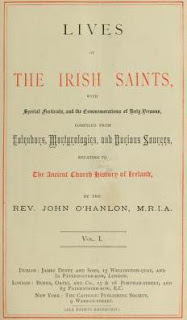
    Another of the many obscure Irish female saints is commemorated on January 4. All we know of Saint Fiadhnat is the recording of her name in the Irish calendars, and in the absence of anything else to say Canon O’Hanlon sounds wonderfully Victorian as he complains about the number of females ‘addicted to idle or frivolous pleasures’:

    St. Fidnatan, or Fiadhnat, Virgin. 

    Numberless females are found in society addicted to idle or frivolous pleasures. Their lives are spent as a taper that wastes away its substance, giving little or only a very flickering light. The name of Fidnatan, virgin, is mentioned in the “Martyrology of Tallagh,” on the 4th of January. Besides this entry, Fiadhnat, the same virgin, is recorded on this day in the “Martyrology of Donegal.” The distinction of sanctity accorded her proves the genuine merits of her well-ordered life.

    Content Copyright © Omnium Sanctorum Hiberniae 2012-2016. All rights reserved.

  • Saint Cillene of Fahan, January 3

    Bell of Saint Mura (UJA, 1853)

    January 3 is the commemoration of a seventh/eighth-century Abbot of Fahan in County Donegal, Cillene Ua Colla. The monastery of Fahan was founded by Saint Mura and various of his successors, including our saint, had the dates of their deaths noted in the Irish Annals. Canon O’Hanlon has this account of Abbot Cillene:

    St. Cillin, or Cillene Ua Colla, Abbot of Fathan-Mura, now Fahan, County of Donegal. 

    [Seventh and Eighth Centuries.]—We find a festival, Cillini Mac h Colla, at the 3rd of January, in the “Martyrology of Tallagh.” In addition to this notice the “Martyrology of Donegal” mentions Cillin Ua Colla, abbot of Fathan-Mura, as having been venerated on this day. The name of this place is sometimes found written Athain and Othain in ancient records. A church was founded here so early as the sixth century by the great St. Columkille. St. Cilline, the descendant of Colla, was born most probably about the middle of the seventh century. The modern designation of his locality is Fahan, within the peninsula of Inishowen, in the county of Donegal. At present, it is said, the old church of Fahan Mura lies close to the eastern shore of Lough Swilly, in the barony of Inishowen, county of Donegal, and in an exceedingly picturesque situation within the ornamental glebe grounds.  In the Annals of Ireland we have on record the death of Ceallach, son of Saran, abbot of Othan-mor or Fahan, A.D. 657. It seems likely the present saint did not succeed him as abbot for many years afterwards, as the death of St. Cillene Ua Colla is set down in the “Annals of the Four Masters,” at A.D. 720, on the 3rd of January. The “Annals of Ulster” place his death at A.D. 724, and the Martyrologists of Donegal seem to adopt this latter computation.

    Content Copyright © Omnium Sanctorum Hiberniae 2012-2016. All rights reserved.

  • A Legend of Saint Scothine

    January 2 is the feast of Saint Scothin, an account of whose life can be found here. Below is a retelling of the most famous of the legends associated with him, by the Irish Anglican writer Maud Joynt:

    LEGEND OF SAINT SCOTHINE

    SCOTHINE, who dwelt at Tech Scothine, in Leinster, was a saint of great piety and of wondrous power;  for he could make the journey from Ireland to Rome in one day and return the next; moreover, he could walk dryshod on the sea. One day while he was walking on the sea he met Saint Barre of Cork, who was in a boat.

    ” How comes it that thou art walking on the sea?” asked Barre .

    ” ‘Tis no sea, but a plain covered with clover,” said Scothine, and, with that, he plucked a clover blossom and threw it to Saint Barre in the boat.

    “But thou, how comes it that thy boat floats on a plain?”

    Thereupon Barre dipped his hand into the water, drew out a salmon and threw it to Scothine; and that was all the answer he made.

    Maud Joynt, The Golden Legends of the Gael, (Dublin, n.d.), Part II, 80.