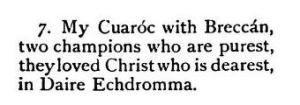
On May 7 we find two saints associated with the place Doire Echdroma, one Saint Berchan, the other Saint Mochiarog. This place may be in County Antrim and Berchan, the son of Saran mentioned in the Tripartite Life of Saint Patrick. It’s all rather confusing, but Pádraig Ó Riain suggests that with their shared feast date and location Berchan and Mochiarog may be doubles of each other. Canon O’Hanlon does his best below to make sense of it all but without much success:
St. Mochiarog, or Mochuarog, of Doire Echdroma.
The present holy person must have flourished, at an early phase of Irish Church affairs, since we find the insertion of Mo-Cuaroc in the Felire of St. Aengus, composed towards the beginning of the ninth century. In the Franciscan copy of the Tallagh Martyrology, after the entry of the previous saint’s feast, as already set forth, we find it united with that of Mochuaroc. However, in the published Martyrology of Tallagh, at the 7th of May, we find recorded Ciaran, who was identical with Mociarocc. With an evident misunderstanding of this entry, the Bollandists quote from the Martyrology of Tallagh, at the 7th of May, and with a remark, that among many similar homonymous saints in the Irish Calendars, they feel unable to identify those given, at this date. This saint—who appears to have been a woman—must have flourished, at rather an early date. Ciarog, as we are told, by the O’Clerys, belonged to the race of Fergus, son to Ros, of the race of Ir, son of Milidh, i.e. of the race of Ciar, son to Fergus, son of Ros, son of Rudhraighe. There was a St. Dachiarog, of Errigal Keeroge, near Ballygawly, in the county of Tyrone. Tradition states, that a former church was built here by a St. Kieran nor is it fairly to be inferred, that a record misunderstood is preferable to a specious tradition. This saint is thought to have been identical with the present Mochiarog—Moch and Dach being commutative forms, attaching to Ciarog, or Ciar. By some, this latter is thought to have been a name only applying to a female saint; the postfix, og, or oig, meaning “virgin.” Now, the derivation of Errigal appears to be from the Irish word ‘Aireagal ‘—pronounced arrigle—which means primarily “a habitation,” but in a secondary sense, it was often applied to an oratory, to a habitation, or to a church. Thus, the Church of Aireagal Dachiarog —now Errigal Keeroge —was once a very important establishment, and it is often mentioned in our Annals. It gave name to the parish. Raths and forts are numerous there while, on an eminence, in the townland so named, are the ruins of the former parochial church of Errigall-Keeroge. The walls are now in a very decayed state, nor do they seem to have been originally good or well built. The remains of an ancient stone cross were near, and also, a well, which the Catholics considered holy. The modern Protestant churchyard, and that of the old church, are the only burying places in the parish. In the beginning of this century, the foundations of a round tower were to be seen, near Ballinasaggard or Priestown, where a convent of Franciscans of the Third Order formerly stood. This parish is in the diocese of Armagh, and in the Union of Clogher. Some curious local legends are connected with the old church, and its supposed patron St. Kieran. The surface of this parish—containing some fine scenery—is uneven and tumulated. Near this place, likewise, Errigal-Truogh is a parish, partly within the barony of Clogher, county of Tyrone; and, it is, in still greater part, within the barony of Truogh, and county of Monaghan. Errigal-Keeroge and Errigal Truogh comprise the nucleus of what was once an extensive principality, known as Oirghealla and, of this kingdom, it is said, Rathmore, near Clogher, was the royal residence. Errigal Truogh is in the diocese of Clogher. The Blackwater River divides both parishes. According to some accounts, Errigal Trough is called in Irish Aireagal-Triucha, interpreted to be ‘the church of (the barony of) Trough.’ The old mail-coach road from Dublin to Londonderry traverses the interior of this parish. Within it are also the ruins of an ancient church. We might ask, if it be possible to derive this latter denomination from such an original, as Aireagal-Trea—the latter portion of the compound being the name of a holy virgin, who is venerated in our calendars, but her name is not found associated with any particular known locality. The Martyrology of Marianus O’Gorman, and the Martyrology of Donegal register, on this day, Berchan and Mochiarog, or Mochuarog, of Echdruim-Brecain, on the confines of Dal Araidhe and Dal Riada, or as the O’Clerys state, in Magh Mucraimhe, in the west of Connacht. They were venerated, at Doire Echdroma, according to the same authorities. In the Martyrology of Christ’s Church, Dublin, at the Nones of May—corresponding with the 9th of this month—we have Ciaroc’s festival set down. The festival of a St. Kiaran, at the 7th of May, is noticed, also, by Father John Colgan. No further accounts of this saint are we able to discover.
 OMNIUM SANCTORUM HIBERNIAE
Leave a comment