April 7 is the feast of an interesting saint, Fíonán (Finan) Cam, of Kinnity, County Offaly but also associated with various locations in County Kerry. The Martyrology of Oengus records on this day:
7. Finan the squinting,of Cenn Etig,around whom ismuch of clamour :
There is a gloss on this entry, added by later anonymous commentators, which reads:
Finán the Crooked of Cenn Etig. Of Húi Luchta was he, i.e. of Corcu Duibne, and of Ciarraige Luachra was his mother. That crookedness was in his eyes, i.e. he looked crookedly at his fosterfather when he was asking something for his guests. “Thou hast leave to be thus, semper,” says the foster father, even Brenainn son of Findlug.
Fíonán Camm, i.e. crooked was his eye, of Cennetig in Sliab Bladma. Of the Corcu-duibne was he.
A salmon of red gold came: it went in the west after sunset, against the womb of white Beccnat, (Finan’s mother) so that it became her husband, (i.e.) when she was bathing in Loch Lein: ut dicitur: Now thou hast no earthly father: the Holy Ghost has saved thee, has fostered thee.Inde alius dixit:Becnat, daughter of vast Idgna, the precious stone that was not scanty: like the Son of the Virgin, Finán Camm was born of her.In Becnat’s womb thou wast for a while, for thou wast conceived thro’ God’s word: an earthly father thou hast not, the Holy Ghost has saved thee, has fostered thee.Finan Camm brought wheat into Ireland, i.e. the full of his shoe he brought. Declan brought the rye, i.e. the full of his shoe. Modomnóc brought bees, i.e. the full of his bell and in one ship they were brought.
Finan is entitled to true circuits, a measure of wheat for every household, the full of his brazen shoe: a tribute that no great saint had taken.
Holy Fíonán belonged to the family of Corca Dhuibhne; his father’s name was Mac Airdhe and his mother was called Beagnaid. This is how he was conceived; his mother saw a fish of reddish colour airborne from the direction of the rising sun, which entered her womb through her mouth, and she conceived from it. She told this to a wise and religious man who said to her: ‘The child in your womb will be a holy man, and he will have grace from God’.Wherever his mother went, for as long as he was in her womb, not a drop of rain, snow or hail touched her garment; her spittle cured every illness and feebleness, and whatever she served of food, however little or poor, it was enough for one and all.
P. Ó Riain, Four Offaly Saints- The Lives of Ciarán of Clonmacnoise, Ciarán of Seir, Colmán of Lynally and Fíonán of Kinnitty (Four Courts Press, 2018), 81.
The gloss on the entry for Finan Cam in the Martyrology of Oengus records the curious tradition that “Finan Camm brought wheat into Ireland, i.e. the full of his shoe he brought. Declan brought the rye, i.e. the full of his shoe. Modomnóc brought bees, i.e. the full of his bell and in one ship they were brought. Finan is entitled to true circuits, a measure of wheat for every household, the full of his brazen shoe: a tribute that no great saint had taken.” This recalls the shrine of Brigid’s shoe in the National Museum, and makes one wonder whether at one time a shoe of Finan Cam was similarly enshrined and venerated, and carried on the due collecting circuits.
I haven’t encountered this tradition of shoes and dues collections before and would like to know more about it. The most recent thinking on the shoe shrine of Saint Brigid though is that it dates to the early eighteenth century.
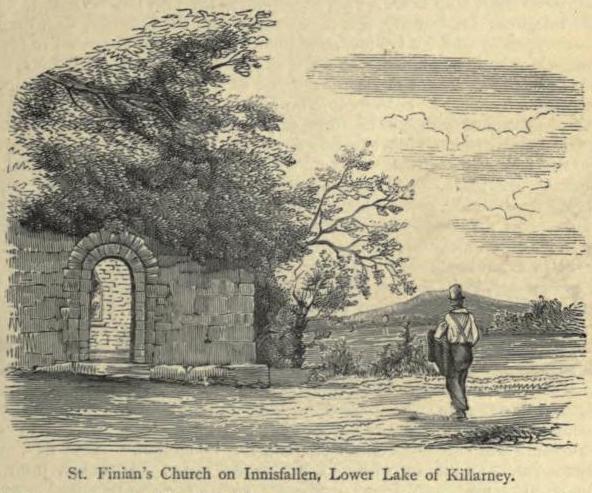
As we have seen, the Martyrology of Oengus associates Saint Fíonán with Kinnitty alone but the Latin Life places him at various locations in County Kerry. The List of Homonymous Saints preserved in the twelfth-century Book of Leinster records eleven saints who share the name Fíonán, so perhaps it is not surprising to find that Saint Fíonán Cam has become entangled with Saint Fíonán Lobair ‘the leper’ of Swords, County Dublin. Fíonán Lobair is credited with the patronage of the church at Innisfallen, which may be because, according to Pádraig Ó Riain’s Dictionary of Irish Saints, in south Kerry Saint Fíonán’s feast was celebrated on 16 March, the feast day of the leprous one of Swords. Modern scholarship suggests that despite this confusion over the feast date it is the Kerry native, Saint Fíonán Cam, who is the true patron of Innisfallen.
Content Copyright © Omnium Sanctorum Hiberniae 2012-2023. All rights reserved.
 OMNIUM SANCTORUM HIBERNIAE
Leave a comment